


Welding Boom Arm: Extend Reach, Improve Fume Extraction
Understanding the Modern Welding Fume Extraction Arm
In industrial environments, particularly those involving welding, the generation of harmful fumes is a significant health and safety concern. Advanced welding boom arm systems are critical components of comprehensive welding air filtration systems designed to capture these hazardous particulates and gases at the source. This document provides a detailed overview of these indispensable tools, focusing on their design, manufacturing, technical specifications, and application in modern industrial settings.
A high-performance welding boom arm, often integrated with a powerful welding gas extractor, ensures worker protection, compliance with stringent environmental regulations, and improved operational efficiency. The continuous evolution of welding processes necessitates equally sophisticated fume extraction solutions, capable of handling diverse materials and welding techniques.
Industry Trends and the Imperative for Advanced Fume Extraction
The global welding market, valued at over $200 billion annually, is experiencing significant growth, particularly in sectors like automotive, construction, and energy. This expansion brings increased regulatory scrutiny regarding industrial air quality. According to data from OSHA and similar international bodies, chronic exposure to welding fumes can lead to severe health issues, including respiratory diseases, neurological damage, and certain cancers. This drives the demand for highly efficient welding air filtration systems.
Key industry trends include:
- Automation and Robotics: Integration with robotic welding cells requires flexible and precise fume extraction solutions that can adapt to automated movements.
- Sustainable Manufacturing: Growing emphasis on energy efficiency, reduced carbon footprints, and recyclable materials in manufacturing processes, including extraction systems.
- Smart Systems: Implementation of IoT and sensor-based monitoring for real-time air quality assessment and predictive maintenance of extraction units.
- Material Diversity: The rise of advanced alloys and composite materials in welding demands versatile extraction arms capable of handling a broader spectrum of fume compositions.
The investment in a robust welding fume extraction arm price is increasingly viewed as a crucial operational expenditure for worker safety and regulatory compliance rather than an optional cost.
Manufacturing Process of a Welding Boom Arm
The production of a high-quality welding boom arm involves meticulous engineering and precision manufacturing processes to ensure durability, optimal functionality, and a long service life of typically 10 to 15 years, depending on usage and maintenance.
Step 1: Design and Material Selection
Utilizing CAD/CAM software for ergonomic and aerodynamic optimization. Materials typically include high-grade steel alloys (e.g., Q235, 304 stainless steel for corrosion resistance) for structural components, reinforced plastics or aluminum for lightweight hoods, and durable, chemical-resistant hoses (e.g., PVC or polyurethane).
Step 2: Component Fabrication
This stage involves precision cutting (laser or plasma), CNC machining for critical articulation joints and brackets, forging for high-stress components, and automated welding for structural integrity. Each part is fabricated to tight tolerances to ensure smooth operation and minimal air leakage.
Step 3: Surface Treatment and Assembly
Components undergo anti-corrosion treatments such as powder coating or galvanization, critical for longevity in harsh industrial environments. Assembly involves integrating the boom arm sections, internal support mechanisms, damper controls, and the extraction hood. Precision balancing is key for effortless maneuverability.
Step 4: Quality Control and Testing
Every unit undergoes rigorous testing conforming to international standards like ISO 9001 (Quality Management), ANSI Z9.2 (Ventilation Standards), and CE directives. Tests include airflow performance verification, structural integrity tests, articulation smoothness, and noise level measurements. This ensures optimal functionality and safety.
Target industries benefiting from these robust arms include petrochemical, metallurgy, automotive manufacturing, heavy fabrication, shipbuilding, and water supply & drainage facilities. The precise engineering ensures energy saving through efficient capture and corrosion resistance for extended operational life.
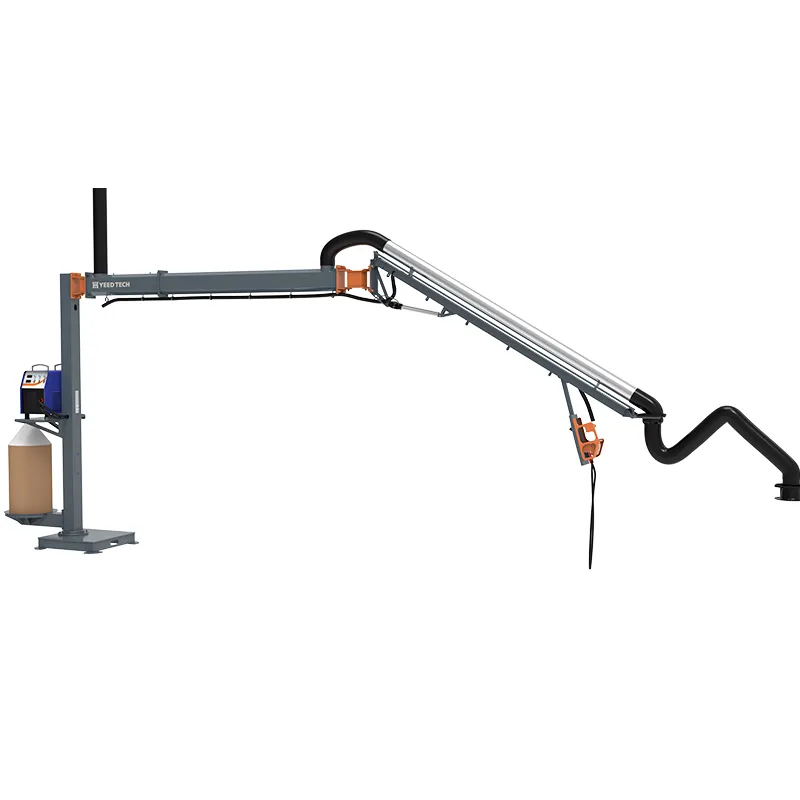
High-performance welding boom arm in a fabrication setting.
Technical Specifications and Parameters
Selecting the appropriate welding boom arm requires a detailed understanding of its technical specifications. Key parameters dictate performance, application suitability, and integration with existing welding air filtration systems.
| Parameter | Description | Typical Range/Value |
|---|---|---|
| Arm Length | Reach from mounting point to hood center. | 2 meters to 5 meters (6.5 ft to 16.4 ft) |
| Duct Diameter | Internal diameter of the flexible hose/duct. | 150 mm to 200 mm (6 in to 8 in) |
| Recommended Airflow | Volumetric flow rate for effective capture. | 1000 m³/h to 2500 m³/h (589 CFM to 1472 CFM) |
| Static Pressure (at inlet) | Pressure required for optimal extraction. | 1200 Pa to 2500 Pa |
| Articulation Points | Number of pivot points for flexibility. | 3 to 5 (e.g., base swivel, elbow joints) |
| Materials | Construction materials for durability. | Powder-coated steel, 304 SS, PP/PVC hose |
| Noise Level (Arm only) | Operational noise generated by the arm itself. | Generally |
| Mounting Options | Ways to affix the arm in the workspace. | Wall, column, ceiling, rail-mounted, mobile |
These specifications are crucial for ensuring the chosen welding boom arm delivers efficient source capture and contributes effectively to overall workshop air quality, aligning with local and international health standards.
Key Technical Advantages of Advanced Fume Extraction Arms
Modern welding boom arm designs offer a suite of technical advantages that contribute to their efficacy and popularity in demanding industrial environments.
- Superior Source Capture: Engineered hoods and optimized airflow dynamics ensure maximum capture efficiency, directly at the welding point, preventing hazardous fumes from dispersing into the breathing zone. This minimizes the burden on general ventilation and associated energy costs.
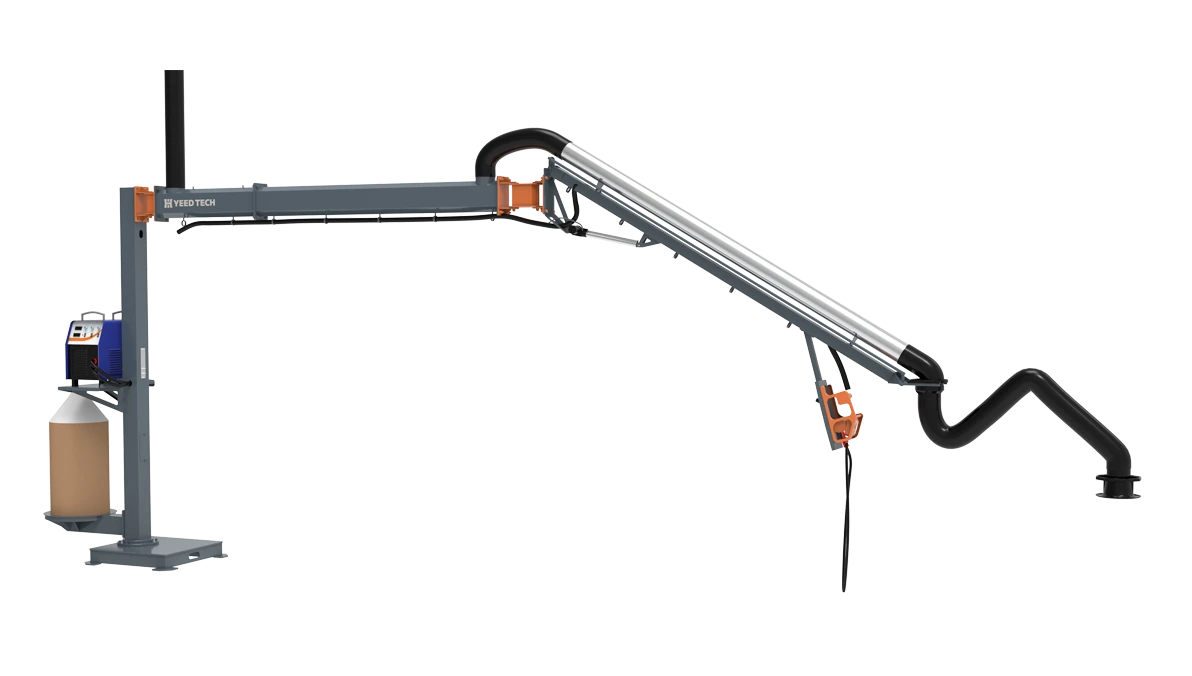
- Robust Articulation and Maneuverability: Multi-jointed designs with internal or external support mechanisms allow for effortless positioning and stability in any desired orientation. Gas springs or friction joints provide smooth, drift-free movement, enhancing operator comfort and productivity.
- Durable Construction: Built from heavy-duty materials, often with corrosion-resistant coatings, these arms withstand harsh welding environments, including sparks, heat, and abrasive dust, ensuring a prolonged operational lifespan.
- Integrated Dampers: Many arms feature adjustable dampers built directly into the hood or arm structure, allowing operators to fine-tune the airflow and suction power for specific welding tasks, contributing to energy saving.
- Modular Design: Facilitates easy installation, maintenance, and potential future upgrades. Components like hoses, joints, and hoods can be replaced independently, reducing downtime and overall maintenance costs.
- Low Noise Operation: Designed with aerodynamic flow paths and quality bearings, these arms contribute minimally to ambient noise levels, promoting a more comfortable and compliant work environment when integrated with a quiet welding gas extractor.
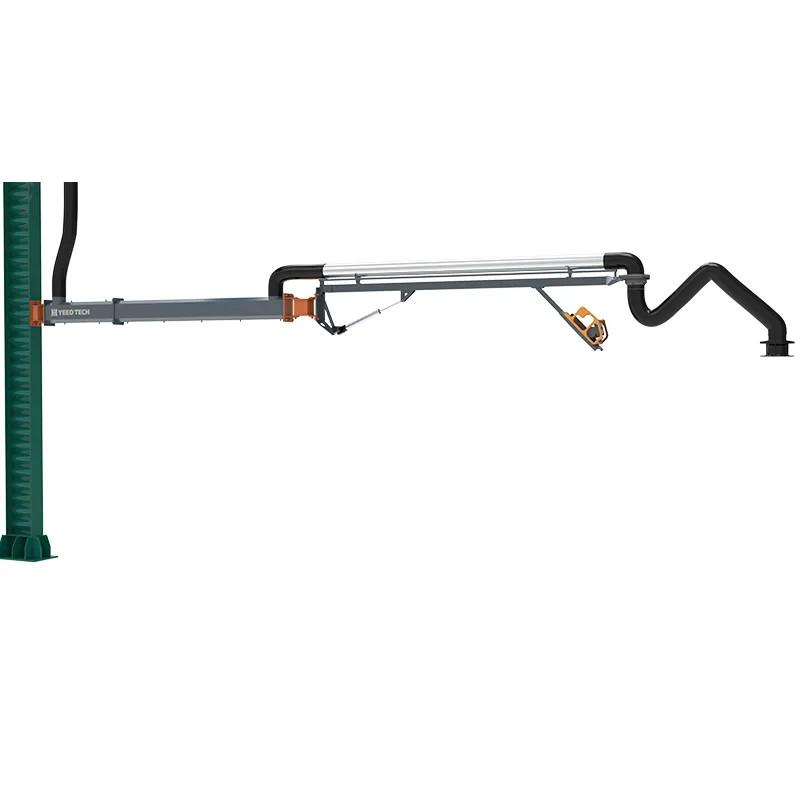
Optimized articulation of a welding fume extraction arm for precise positioning.
Application Scenarios Across Industries
The versatility of the welding boom arm allows for effective fume extraction in a multitude of demanding industrial environments.
- General Fabrication Workshops: Essential for manual welding stations, ensuring local exhaust ventilation for diverse welding tasks on various metals.
- Automotive Manufacturing: Used in body assembly, chassis fabrication, and repair shops, handling fumes from mild steel, aluminum, and advanced high-strength steels.
- Heavy Machinery & Shipbuilding: Critical for large-scale welding operations on heavy components, often requiring longer reach arms and robust capture capabilities.
- Energy Sector (Oil & Gas, Power Plants): Indispensable for maintenance and construction, particularly when welding in confined spaces or on specialized alloys, demanding explosion-proof or ATEX-certified options for safety.
- Educational & Training Facilities: Provides safe learning environments for welding students, preventing exposure to harmful fumes.
- Aerospace Industry: For precision welding of lightweight and exotic alloys, requiring highly efficient and contaminant-free extraction.
- Petrochemical Industry: Demands corrosion resistance and explosion-proof features due to the presence of flammable gases and corrosive substances.
In these scenarios, the welding boom arm provides crucial source capture, reducing overall exposure to welding fumes and improving overall air quality.
Customized Solutions for Unique Industrial Needs
Recognizing that no two welding environments are identical, leading manufacturers offer highly customized welding boom arm solutions. This allows for optimal integration and performance, addressing specific spatial constraints, material types, and regulatory requirements.
- Extended Reach Arms: For large workpieces or multiple workstations, arms can be designed with lengths up to 10 meters, often supported by rail-mounted systems.
- Specialized Hood Designs: From wide-capture hoods for large fume plumes to narrow, focused hoods for precision welding, designs can be tailored for maximum capture efficiency. Options include LED lighting integration and magnetic attachments.
- Material-Specific Construction: Arms for corrosive environments (e.g., stainless steel fabrication) can be made from 304 or 316 stainless steel. For environments with explosive dust or gases, ATEX-certified components are crucial.
- Integrated Control Systems: Synchronization with welding machines or air quality monitors for automatic on/off operation, maximizing energy efficiency and extending filter life.
- Mobile and Stationary Options: Custom mounting solutions include wall, column, ceiling, and mobile units, offering flexibility for dynamic workshops or dedicated welding bays.
These tailored solutions ensure that the welding fume extraction arm price reflects a precise fit for purpose, delivering long-term value and superior air quality control.
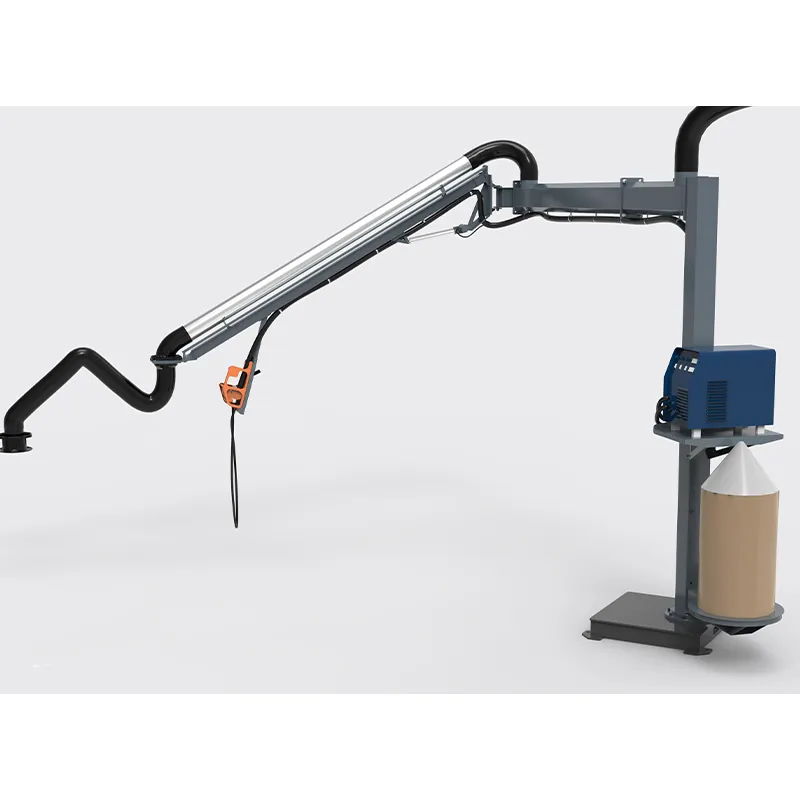
Customized welding boom arm with extended reach and specialized hood.
Vendor Comparison: Selecting the Right Fume Extraction Arm
When evaluating vendors for a welding boom arm, it's essential to consider factors beyond just the welding fume extraction arm price. A holistic comparison ensures optimal performance, durability, and support.
| Feature | Vendor A (e.g., YEEEED) | Vendor B (Competitor) | Vendor C (Competitor) |
|---|---|---|---|
| Arm Length Range | 2m - 5m standard; up to 8m custom | 2m - 4m standard | 2.5m - 5.5m standard |
| Duct Material | High-temp PVC/Polyurethane | Standard PVC | Fire-resistant PP |
| Support Mechanism | Internal spring/gas strut balanced | External friction joints | Internal friction with external springs |
| Certifications | CE, ISO 9001, TUV | CE | ISO 9001 |
| Corrosion Resistance Options | Standard & 304/316 SS models | Standard only | Limited SS options |
| Integrated Damper | Yes, at hood & central joint | Yes, at hood | No |
| Warranty (Structural) | 5 Years | 2 Years | 3 Years |
YEEEED, for example, emphasizes robust construction, versatile design (e.g., multiple mounting options including mobile), and comprehensive after-sales support, reflecting their commitment to quality and customer satisfaction over more than a decade in the industry. Reputable vendors will openly share test data, such as airflow rates, static pressure drops, and filtration efficiency, validated by third-party organizations.
Application Case Studies: Real-World Impact
The implementation of well-designed welding boom arm systems consistently demonstrates tangible benefits in diverse industrial settings.
Case Study 1: Heavy Equipment Manufacturer
A major heavy equipment manufacturer faced challenges with pervasive welding fumes in their large fabrication shop, leading to complaints about air quality and potential regulatory fines. They installed 15 long-reach (4-meter) welding boom arm units integrated with a central welding gas extractor system. Post-installation air quality monitoring showed a 95% reduction in particulate matter concentrations at worker breathing zones. This resulted in improved employee morale, reduced absenteeism, and full compliance with local environmental health standards. The robust articulation allowed operators to easily position the hoods over large chassis components.
Case Study 2: Automotive Parts Supplier
An automotive tier-1 supplier operating robotic welding cells struggled with fume accumulation that interfered with sensor accuracy and robot maintenance. They deployed compact, ceiling-mounted welding boom arm systems with specialized hoods, precisely positioned to capture fumes without obstructing robotic movements. The arms were constructed with materials resistant to potential spark damage. This solution not only protected employees but also significantly improved robot uptime by reducing maintenance related to fume build-up, demonstrating a rapid return on investment.
Case Study 3: Technical Training College
A technical college needed a safe and efficient fume extraction system for its new welding lab, accommodating multiple student workstations. They chose mobile welding boom arm units on portable filtration carts, allowing flexible lab configurations. The system provided excellent source capture, ensuring students learned in a healthy environment. The low welding fume extraction arm price for the integrated mobile units made it an economical yet highly effective solution for the institution.
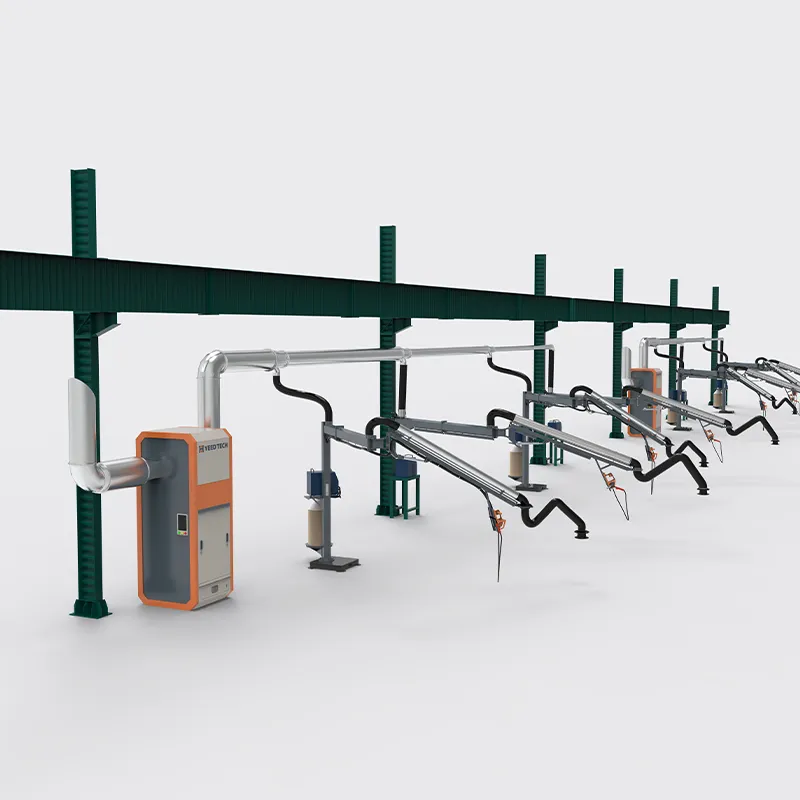
Welding boom arm deployed in an educational welding workshop.
Ensuring Compliance, Certifications, and Trustworthiness ( Focus)
Authoritativeness and trustworthiness are paramount in the B2B sector. Our products, including the welding boom arm, are designed and manufactured to meet rigorous international standards.
Certifications and Standards:
- ISO 9001:2015: Our manufacturing processes adhere to the highest international quality management standards, ensuring consistent product excellence.
- CE Marking: Products comply with European Union safety, health, and environmental protection requirements.
- TÜV Certification: Independent third-party validation for safety and quality.
- ANSI Z9.2: Designed to meet or exceed American National Standards Institute guidelines for local exhaust ventilation.
Customer Feedback & Experience:
"The YEEEED welding boom arm significantly improved our workshop air quality. Its easy maneuverability and robust build quality are exactly what we needed for our heavy fabrication tasks. The installation was seamless, and the after-sales support has been exemplary." - Production Manager, Heavy Industry Client.
With over 10 years of experience in providing industrial air purification solutions, we partner with leading firms in metallurgy, energy, and automotive sectors, consistently delivering reliable and high-performance products.
Frequently Asked Questions (FAQ)
- Q1: What length of welding boom arm do I need?
- A1: The ideal length depends on the size of your workspace and the typical dimensions of the workpieces. Measure the maximum reach required from your chosen mounting point to the furthest welding position. Our technical team can assist with precise calculations.
- Q2: Can a welding boom arm be used with any welding air filtration systems?
- A2: Most standard fume extraction arms are compatible with a range of central or mobile filtration units, provided the fan generates sufficient static pressure and airflow for the chosen arm length and duct diameter. We recommend checking the specifications of your existing system.
- Q3: What maintenance is required for a welding boom arm?
- A3: Maintenance typically involves periodic inspection of joints for wear, checking hose integrity, ensuring damper functionality, and lubricating moving parts as per manufacturer guidelines. Minimal maintenance ensures long-term, reliable operation.
- Q4: Are specialized welding boom arm available for corrosive or explosive environments?
- A4: Yes, we offer models constructed from stainless steel (e.g., 304 or 316 SS) for corrosive environments and ATEX-certified versions for potentially explosive atmospheres, ensuring compliance and safety in specialized applications.
Lead Time, Warranty, and Customer Support:
- Lead Time: Standard welding boom arm units typically ship within 2-4 weeks. Customized solutions may require 6-8 weeks, depending on complexity.
- Warranty: We offer a comprehensive 5-year warranty on structural components and 1-year on wear parts (e.g., hoses) for our welding boom arm products, demonstrating our confidence in their durability.
- Customer Support: Our dedicated technical support team is available via phone and email for installation guidance, troubleshooting, and spare parts inquiries, ensuring minimal downtime for your operations.
Conclusion
The modern welding boom arm is far more than a simple exhaust component; it is a meticulously engineered tool essential for worker safety, regulatory compliance, and operational efficiency in welding environments. By understanding the intricate manufacturing processes, key technical advantages, and diverse application scenarios, industrial decision-makers can make informed choices, ensuring optimal air quality and long-term value. Investing in a high-quality welding boom arm from a reputable vendor is a strategic decision that safeguards health, enhances productivity, and underpins sustainable industrial practices.
References
- Occupational Safety and Health Administration (OSHA). "Welding Fumes and Gases." U.S. Department of Labor.
- American National Standards Institute (ANSI) Z9.2. "Fundamentals Governing the Design and Operation of Local Exhaust Systems."
- International Organization for Standardization (ISO) 9001. "Quality management systems — Requirements."
- European Agency for Safety and Health at Work (EU-OSHA). "Exposure to welding fumes in the workplace."
Latest News
-
Efficient automated hot air drying equipment for steel structure application
NewsApr.16,2026 -
Efficient hot air drying system for steel structure spraying line
NewsApr.09,2026 -
Optimizing Steel Structure Spraying with Hot Air Drying Technology Solutions
NewsApr.07,2026 -
HighEfficiency Hot Air Drying Painting Equipment for Superior Industrial Coatings
NewsApr.04,2026 -
Optimizing Industrial Processes with Hot Air Furnace Heating Spraying Systems
NewsMar.31,2026 -
Comprehensive Tailormade Steel Structure Spraying Solution for Enhanced Durability
NewsMar.28,2026 -
Optimizing Steel Structure Protection through Customization and Integration of Spraying System
NewsMar.26,2026


